


Have you ever noticed that your mind is busy thinking about the past or the future while your body is simply here in the present moment?
Body scan meditation is a mindfulness practice that invites you to slow down and bring your attention to different parts of your body. Instead of trying to clear your mind or change what you are feeling, you simply observe physical sensations with curiosity and without judgment.
You may notice areas of tension, warmth, pressure, tingling, heaviness, or even places where you do not feel much at all. There is no right or wrong sensation to experience. The practice is about becoming more aware of what is happening in your body, moment by moment.
Body scan meditation can be practiced while lying down, sitting, or in another comfortable position. It is often used as part of mindfulness practices and can be a simple way to reconnect with yourself when life feels busy or overwhelming.
In this guide, we will explore what body scan meditation is, how it works, its potential benefits, and how to practice it step by step. We will also look at how body awareness can complement meditation and manifestation practices.
Body scan meditation is a mindfulness technique in which you deliberately move your attention through different areas of the body, usually from one end of the body to the other.
Rather than focusing on just one object, such as the breath, you gradually notice what you can feel in different parts of your body. You might begin with your feet and slowly move your awareness through your legs, hips, abdomen, chest, arms, shoulders, neck, and head.
The goal is not to analyze your body or decide whether a sensation is good or bad. Instead, you practice noticing.
For example, you may become aware that your shoulders feel tight or that your hands feel warm. You might notice your breathing moving through your chest or the sensation of your body resting against the surface beneath you.
When your attention wanders, you simply acknowledge it and gently bring your awareness back to the part of the body you are observing.
This makes body scan meditation less about doing something to your body and more about developing a closer relationship with your present experience.
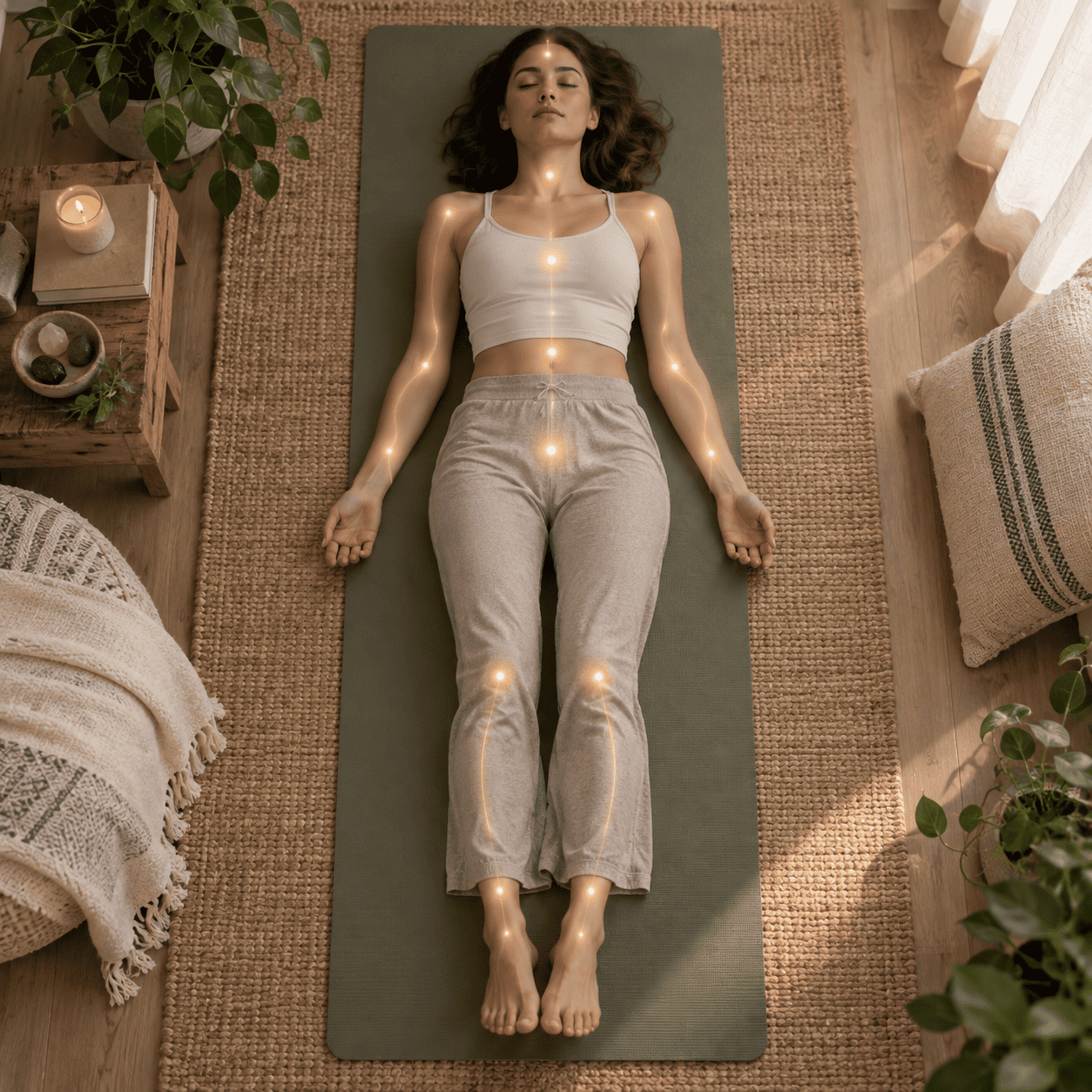
We often spend much of the day focused on thoughts, tasks, notifications, conversations, and everything happening around us. As a result, it can be easy to overlook physical sensations until they become particularly noticeable.
A body scan creates intentional space to pause and check in with yourself.
Body awareness is an important component of many mindfulness practices. Research examining the relationship between mindfulness and body awareness has found evidence of an association between mindfulness and interoceptive awareness, although researchers note that the size and consistency of this relationship still require further study.
This does not mean that every physical sensation has a particular emotional or spiritual meaning. Instead, body scan meditation encourages a simple practice of awareness, curiosity, and presence.
And sometimes, that pause is all you need to step out of autopilot and reconnect with the moment you are actually living.
Body scan meditation works by directing your attention toward physical sensations instead of allowing your mind to remain caught up in thoughts, worries, or distractions.
The practice is usually slow and intentional. Rather than trying to concentrate on your entire body at once, you focus on one area at a time and gradually move your awareness through the body.
You might begin at your toes, for example, and spend a few moments noticing what you can feel there. Then, you slowly move your attention toward your feet, ankles, calves, knees, and the rest of your body.
As you do this, you may notice different sensations from one moment to the next.

There is no specific sensation you need to experience during a body scan. Your experience can be completely different from someone else’s.
You might notice:
The important part is not what you feel, but how you relate to what you feel.
Instead of immediately labeling a sensation as uncomfortable or pleasant, you can simply observe it. This creates an opportunity to practice awareness without automatically reacting to every sensation.
Your mind will probably wander during a body scan. That is completely normal.
You may start thinking about something you need to do, remembering a conversation, planning your day, or becoming distracted by a sound around you.
The goal is not to prevent thoughts from appearing.
When you notice that your attention has drifted, gently acknowledge it and return your attention to your body. Each time you do this, you are practicing mindfulness.
In this sense, the wandering mind is not a failure of meditation. Returning to the present is part of the practice itself.
Body scan meditation is closely connected to mindfulness, which involves intentionally paying attention to the present moment with an attitude of openness and without unnecessary judgment.
Many mindfulness practices use the breath as an anchor. A body scan offers another way to develop present-moment awareness by using physical sensations as the focus of attention.
This can be especially useful if you tend to spend a lot of time inside your thoughts. Bringing attention back to the body gives you a tangible experience happening right now.
For example, instead of thinking “I am stressed,” you might pause and notice what stress feels like physically. Perhaps your jaw feels tight, your shoulders are raised, or your breathing feels different.
You do not have to immediately fix or change these sensations. First, you simply become aware of them.
Body scan meditation is still meditation, but its main point of focus is different from some other common practices.
In a breath-focused meditation, you repeatedly return your attention to the sensation of breathing. In a body scan, you move your attention through different areas of the body and observe the sensations you find there.
Both practices can encourage present-moment awareness, but the experience can feel quite different.
A body scan may also be a useful option for people who find it easier to concentrate on something tangible rather than trying to focus on the breath alone.

The purpose of a body scan is not to force your body to relax or to make every uncomfortable sensation disappear.
Instead, the practice gives you an opportunity to slow down, notice, and become more aware of your physical experience.
With practice, you may become better at recognizing when your body feels tense, restless, comfortable, tired, or energized. This increased awareness can help you develop a more intentional relationship with your body rather than moving through the day completely on autopilot.
Body scan meditation is therefore less about achieving a particular state and more about learning to be present with the state you are already experiencing.
Body scan meditation is a simple practice, but regularly bringing your attention back to your body can support several aspects of mindfulness and self-awareness.
Research has examined body scan meditation as a standalone mindfulness practice. A systematic review and meta-analysis indexed by the National Library of Medicine found a small positive effect on mindfulness, while also noting limitations in the quality and consistency of the available evidence.
More broadly, mindfulness-based practices have been studied for their potential effects on stress and psychological well-being. However, results can vary from person to person, and body scan meditation should not be viewed as a replacement for professional medical or mental health care.
Here are some of the ways a body scan may support your overall mindfulness practice.
One of the main purposes of a body scan is to become more aware of physical sensations.
During everyday life, you may not notice that your shoulders are tense, your jaw is clenched, or your breathing has changed until you finally stop and pay attention.
A body scan encourages you to check in with your body regularly. Over time, this can help you become more familiar with subtle sensations and recognize what is happening physically in the present moment.
It is easy for the mind to become absorbed in memories, plans, worries, and endless mental to-do lists.
The body, however, is always experiencing something in the present.
When you focus on the sensation of your feet, the movement of your breath, or the feeling of your body resting against a surface, your attention is directed toward something happening right now.
This makes the body a practical anchor for mindfulness.
A body scan can help you identify areas of tension that you may not have consciously noticed.
You might discover that your shoulders feel tight after a long day at your computer or that you are holding tension in your face while concentrating.
Simply noticing these sensations does not necessarily make them disappear, but awareness can be the first step toward responding to your body more intentionally.
Body scan meditation is often practiced as part of relaxation and mindfulness routines.
Moving slowly through the body can encourage you to pause from daily activities and shift your attention away from constant external stimulation.
Rather than forcing yourself to relax, you allow yourself to notice what is already happening in your body.
For some people, this slower pace can create a sense of calm and make the practice a useful addition to a bedtime or evening routine.
We often think of the mind and body as separate, but our everyday experience constantly connects the two.
A stressful situation can affect your breathing or muscle tension. Excitement can change your heart rate. A peaceful moment can feel different throughout your body.
Body scan meditation gives you an opportunity to observe these connections without immediately trying to interpret them.
With practice, you may become more attentive to the relationship between your thoughts, emotions, and physical sensations.
During a body scan, you may encounter sensations that feel pleasant, uncomfortable, neutral, or difficult to describe.
Instead of immediately thinking “I like this” or “I need this to stop,” you practice simply noticing.
This can help develop a more accepting attitude toward your moment-to-moment experience.
The goal is not to approve of every sensation. It is to observe what is there without adding unnecessary judgment.
Sometimes the biggest benefit of a meditation practice is simply creating intentional space in your day.
A body scan gives you permission to stop, breathe, and check in with yourself instead of constantly moving from one task to another.
Even a few minutes can become a small transition between doing and simply being.
Body scan meditation is commonly included in mindfulness-based programs that aim to support stress management and overall well-being. Research on brief mindfulness exercises has found that body scan meditation may help reduce short-term self-reported stress, although individual experiences and longer-term effects can vary.
The practice may help you become more aware of how stress shows up in your body. For example, you may notice muscle tension, changes in breathing, restlessness, or other physical sensations.
Rather than automatically reacting to these sensations, you practice observing them.
This does not mean that a body scan can eliminate stress or prevent stressful situations. Instead, it can become one tool for developing greater awareness of your responses to everyday experiences.
And sometimes, awareness creates the small pause we need before automatically reacting.
Body scan meditation can be a gentle practice, but mindfulness does not necessarily feel comfortable for everyone at every moment.
Focusing closely on physical sensations may sometimes bring attention to discomfort, difficult emotions, or memories. If the practice feels overwhelming, you can stop, open your eyes, shift your attention toward your surroundings, or choose another grounding activity.
There is no requirement to push through discomfort simply because you are meditating.
Mindfulness is about awareness, not forcing an experience.

You do not need a special space, complicated technique, or previous meditation experience to practice a body scan.
All you need is a few quiet minutes and a comfortable position. You can practice lying down, sitting in a chair, or in another position that allows you to remain relatively still.
If you are a beginner, start with five to ten minutes and gradually increase the duration as the practice becomes more familiar.
Choose a position in which you can stay comfortably for several minutes.
You can lie on your back with your arms resting naturally beside you, or sit comfortably with your feet supported by the floor.
There is no single “perfect” meditation position. The goal is to be comfortable enough to pay attention without constantly adjusting your body.
Close your eyes if that feels comfortable. If not, you can keep them softly open.
Before beginning the body scan, take a few natural breaths.
You do not need to change your breathing or make it deeper than usual. Simply notice the sensation of breathing.
Feel the air moving in and out, the gentle movement of your chest or abdomen, or whatever part of the breathing process is most noticeable to you.
Let your breath become an anchor for your attention.
Begin directing your attention toward your feet.
Notice whatever sensations are present.
You might feel warmth, coolness, pressure, tingling, movement, or contact with the floor or bed. You may also notice very little.
There is nothing you need to create.
Simply observe.
Gradually move your awareness through the rest of your body.
You can follow a sequence such as:
Feet → ankles → calves → knees → thighs → hips → abdomen → chest → hands → arms → shoulders → neck → face → head.
Spend a few moments with each area.
As you move from one part to another, notice the sensations without needing to analyze them.
If you discover tension somewhere, you do not have to force it to relax. Simply acknowledge that the tension is there.
As you scan your body, try to observe sensations without immediately categorizing them as good, bad, right, or wrong.
For example, instead of thinking:
“My shoulders are too tense.”
You might simply notice:
“There is tightness in my shoulders.”
This small shift changes your relationship with the sensation. You are observing rather than immediately reacting.
At some point, your thoughts will probably drift away from the body.
You might start planning tomorrow, remembering something from earlier, or wondering how much time is left.
When you notice this happening, gently bring your attention back.
You do not need to criticize yourself for becoming distracted.
Noticing that your mind wandered and returning to the present is part of meditation.
Once you have moved through the different areas, take a moment to notice your body as a whole.
Feel the contact between your body and the surface beneath you.
Notice your breathing and any sensations that stand out.
You do not need to search for anything specific. Simply allow yourself to experience your body as it feels in this moment.
When you are ready to finish, bring your attention back to your surroundings.
Notice the sounds around you. Feel the surface supporting you. If your eyes are closed, slowly open them.
Take a moment before immediately returning to your next task.
You can ask yourself:
“What do I notice in my body right now?”
There is no particular answer you need to find. The question itself encourages you to pause and check in with your present experience.
If you would like to practice without having to remember every step, you can use this simple script:

Find a comfortable position and allow your body to settle.
Bring your attention to your breathing. Notice each natural inhale and exhale.
Slowly bring your awareness to your feet. Notice any sensations without judging them.
Move your attention upward through your legs, hips, abdomen, chest, arms, shoulders, neck, and head.
If your mind wanders, gently return your attention to the part of the body you are observing.
Notice areas of tension, comfort, warmth, pressure, or stillness.
Finally, become aware of your whole body and take a few natural breaths.
When you are ready, slowly return your attention to your surroundings.
You can practice this script slowly, leaving several moments of silence between each section.
The more often you practice, the less you may need to follow a script. Eventually, simply noticing your body can become a natural way to return your attention to the present moment.
There is no required length for a body scan meditation.
A beginner might start with 5 to 10 minutes, while a longer practice can last 20, 30, or even 45 minutes depending on the person’s routine and preference.
Consistency can be more practical than trying to meditate for a long time occasionally.
You could begin with a short body scan once a day and increase the duration when it feels comfortable.
Even a brief pause can give you an opportunity to step away from automatic activity and reconnect with your body.
If you are new to meditation, body scan meditation can be a simple way to begin developing mindfulness without needing to know complicated techniques.
At first, it may feel unusual to spend several minutes paying attention to sensations that you normally ignore. You might also find that your mind wanders frequently or that you become impatient.
That is completely normal.
Meditation is not about having a perfectly quiet mind. It is about practicing the ability to notice where your attention is and gently bring it back.
You do not need to begin with a 30-minute meditation.
Try starting with five minutes. Once that feels comfortable, you can gradually increase the length of your practice.
A short meditation that you can practice consistently may be easier to maintain than a long session that feels like another task on your to-do list.
One common misunderstanding is that you need to feel completely relaxed for a body scan to “work.”
That is not the purpose of the practice.
Some days you may feel calm. Other days you may notice tension, restlessness, or discomfort.
Your job is simply to observe what is present.
The experience does not have to be peaceful to be mindful.
When you move your attention through your body, you may notice very clear sensations in some areas and almost nothing in others.
Both experiences are completely fine.
You do not need to invent a sensation or concentrate harder until you feel something.
Simply noticing “I don’t notice much here” is itself an observation.
There is no universal best time to practice a body scan.
Some people enjoy it in the morning as a way to begin the day with awareness. Others prefer an evening practice when they want to slow down after a busy day.
You can also use a short body scan as a transition between activities.
The most useful time is often the one you can realistically make part of your routine.
Although body scan meditation is simple, beginners sometimes put unnecessary pressure on themselves.
Here are a few common mistakes to avoid.
Thoughts are going to appear.
Trying to eliminate every thought can actually become another source of frustration.
Instead, notice when your attention has wandered and gently return to the body.
You may notice something uncomfortable and immediately think:
“I shouldn’t be feeling this.”
Try replacing judgment with curiosity.
Instead of deciding what the sensation means, simply observe its qualities. Is it sharp, dull, warm, cold, heavy, tight, or changing?
You do not have to create a story around every physical sensation.
A body scan is not something you need to rush through.
If you spend only a second on each body part, it can become difficult to develop meaningful awareness.
Give yourself enough time to actually notice what is happening.
Your body and mind are different every day.
One session might feel deeply calming. Another might feel distracting or uncomfortable. Sometimes you may notice many sensations, while other times everything may seem relatively quiet.
Try not to compare one meditation with another.
Each practice is simply an opportunity to notice what is happening now.

There is no score for meditation.
You are not failing because you became distracted, moved your body, or struggled to concentrate.
The practice is the process of noticing and returning.
That is enough.
Absolutely.
Although body scans are often associated with lying down, you can practice them while sitting in a chair, on a cushion, or in another comfortable position.
Sitting can be particularly practical when you want to practice during the day without becoming too sleepy.
Keep your posture comfortable and allow your body to remain naturally supported. You do not need to force yourself into a rigid meditation position.
Yes.
Closing your eyes can make it easier to direct attention inward, but it is not required.
If closing your eyes feels uncomfortable, keep them softly open and allow your gaze to rest naturally on a point in front of you.
The goal is to develop awareness of your body, not to follow a particular visual rule.
Not every meditation session will feel comfortable.
Paying close attention to your body can sometimes make sensations more noticeable than they were before. If you experience discomfort, you can adjust your position, open your eyes, pause the practice, or bring your attention to your surroundings.
You never need to force yourself to continue.
Mindfulness is an invitation to become more aware of your experience, not a requirement to ignore your own boundaries.
Body scan meditation is often included in evening mindfulness and relaxation routines because it encourages you to slow down and shift your attention away from the activity of the day.
When you are lying in bed with a busy mind, focusing on physical sensations can give your attention something simple and present to return to.
Instead of repeatedly thinking about tomorrow’s responsibilities or replaying the day, you can notice the feeling of your body resting against the mattress, the movement of your breathing, and the sensations throughout your body.
A bedtime body scan can be very simple.
Lie down in a comfortable position and allow yourself to settle. Then gradually move your attention from your feet toward your head, noticing sensations along the way.
You do not need to complete the entire scan if you become sleepy.
If thoughts appear, acknowledge them and gently return to the sensations in your body.
You can also combine the practice with slow, natural breathing and a comfortable environment with minimal distractions.
The intention is not to force yourself to fall asleep. Instead, allow the body and mind to gradually transition into a quieter part of the day.
Although the two practices can overlap, they are not exactly the same.
A body scan meditation focuses primarily on observing physical sensations throughout the body.
A sleep meditation may use a wider range of techniques, such as breathing exercises, visualization, calming imagery, or guided relaxation, with the specific intention of preparing you for sleep.
A body scan can therefore be part of a bedtime meditation routine without needing to be specifically designed as a sleep meditation.

Manifestation practices often encourage you to become more intentional about your thoughts, emotions, beliefs, and actions.
Body scan meditation can complement this process by adding another dimension: awareness of your physical experience.
When you slow down and notice your body, you create a moment to check in with yourself before moving into practices such as visualization, affirmations, gratitude, or intention setting.
The body scan itself does not magically manifest a specific outcome. Instead, it can serve as a mindfulness practice that helps you become more present and intentional.
Visualization involves mentally imagining a desired experience or outcome.
Before beginning a visualization practice, you could spend a few minutes doing a body scan.
Start by noticing your feet, legs, hips, abdomen, chest, arms, shoulders, neck, and head.
Once you feel more grounded in the present moment, transition into your visualization.
This creates a simple sequence:
Body awareness → Presence → Intention → Visualization
The purpose is not to force a particular feeling or convince yourself that something has already happened. It is simply a way to approach your manifestation practice with greater awareness.
Our emotions can have physical components.
You might notice your heart beating faster when you are excited, tension in your shoulders when you feel pressured, or a sensation in your stomach when something makes you nervous.
A body scan can help you become more curious about these physical experiences.
Instead of immediately reacting to an emotion, you can pause and ask:
“What am I noticing in my body right now?”
That simple question can create a moment between experiencing something and automatically reacting to it.

Manifestation does not have to be about constantly thinking about the future.
You can also use mindfulness to become more aware of the present moment while you work toward your intentions.
A body scan can support this grounded approach by reminding you to come back to your actual experience.
You can think of it as a gentle transition from thinking about what you want to becoming aware of where you are right now.
From there, you can move into other practices that are meaningful to you, such as affirmations, gratitude, meditation, or visualization.
You do not need a long meditation session to practice body awareness.
If you only have five minutes, try this simple version:
Minute 1 — Arrive
Find a comfortable position and notice your breathing. Feel the surface supporting your body.
Minute 2 — Lower Body
Bring your attention to your feet and legs. Notice any sensations without trying to change them.
Minute 3 — Center of the Body
Move your awareness toward your hips, abdomen, and chest. Notice the movement created by your natural breathing.
Minute 4 — Upper Body
Bring your attention to your hands, arms, shoulders, neck, face, and head.
Notice areas of tension, warmth, pressure, or stillness.
Minute 5 — Whole Body
Allow your attention to expand to your entire body.
Take a few natural breaths and notice how you feel in this moment.
When you are ready, gently return your attention to your surroundings.
You can use this five-minute practice on its own or before another mindfulness or manifestation practice.
Body scan meditation does not have to be something you only practice during a formal meditation session.
Once you become familiar with the technique, you can bring small moments of body awareness into your everyday routine.
You might pause for a minute before starting work, check in with your body after spending hours at a desk, or take a few moments to notice your breathing before beginning a visualization practice.
The practice can be as simple as stopping and asking yourself:
“What am I noticing in my body right now?”
There is no need to find a particular answer.
Sometimes you may notice tension. Other times you may feel relaxed, tired, energized, or simply neutral. The important thing is creating the habit of paying attention.
If you want to develop a regular body scan practice, choose a moment that naturally fits into your day.
You could practice:
You can also combine body awareness with other practices you already enjoy.
For example, you might begin with five minutes of body scan meditation and then move into gratitude, affirmations, visualization, or intention setting.
The goal is not to create another obligation. It is to create a small space where you can reconnect with yourself.
You do not need to wait until you feel stressed, distracted, or disconnected to check in with your body.
Your body is experiencing the present moment all the time.
A body scan simply gives you a reason to pause and notice it.
With practice, this simple act of awareness can become a meaningful part of your mindfulness routine, and a grounded way to approach your inner work.
Body scan meditation is a mindfulness practice that involves slowly directing your attention through different areas of your body and noticing physical sensations without judgment.
A body scan can last anywhere from a few minutes to 30 minutes or longer. Beginners can start with five to ten minutes and gradually increase the duration according to their comfort and routine.
Yes. Body scans are often practiced while lying down, but you can also practice while sitting in a chair, on a cushion, or in another comfortable position.
Focus on the physical sensations you can notice in each area of your body. These might include warmth, coolness, pressure, tingling, tension, heaviness, movement, or the absence of a noticeable sensation.
Mind wandering is completely normal. When you notice that your attention has moved elsewhere, gently acknowledge it and bring your attention back to the part of the body you are observing.
A body scan can be included in a relaxing bedtime routine and may help you shift your attention away from daily thoughts and toward present-moment sensations. However, it should not be considered a guaranteed treatment for sleep problems.
Body scan meditation is one type of mindfulness practice. It uses awareness of physical sensations as the main focus, while mindfulness can also involve practices centered on breathing, thoughts, emotions, sounds, or other aspects of present-moment experience.
Body scan meditation does not directly manifest a particular outcome. However, it can complement manifestation practices by encouraging present-moment awareness before activities such as visualization, affirmations, gratitude, or intention setting.
Yes. Body scan meditation does not require previous meditation experience. Beginners can start with a short five-minute practice and gradually become more comfortable with the technique.
You can pause the practice, change your position, open your eyes, or bring your attention to your surroundings. Meditation should not require you to push through experiences that feel overwhelming or unsafe.